

The Missing Skill in Hospitality Leadership: Why Translation Drives Performance
In more than 25 years of hospitality — from boutique hotels to large groups, from cultural institutions to multi-country portfolios — one insight has become the silent foundation of my leadership philosophy:
.
Not PowerPoints.
But people. Expectations. Pressure. Complexity.
They translate what the organisation , what owners hope for, what teams need, and what guests ultimately feel.
And the more I worked in high-pressure environments, the clearer it became.
They fail because nobody has translated what the work really means today.
Hospitality has become more complex — and leaders are expected to make it simple.
Our industry is changing rapidly.
Labor shortages are no longer a temporary challenge; they are the new reality.
Brands are growing faster than their internal alignment can keep up with.
Digitization offers opportunities, but also overwhelms.
Ownership structures become layered: owners, asset managers, operators, HQ teams, local teams — each with their own language and priorities.
Meanwhile, guest expectations are rising faster than operational capacity.
Teams don't struggle with work.
They struggle with interpretation.
Every day, I see the same gap emerging between what leaders say and what teams hear.
A brand guideline is perceived as personal criticism.
A strategic priority is perceived as pressure.
A request from the owner turns into a rumor on the work floor.
Not because people are unwilling, but because no one has translated what was meant, what was expected, and how it fits into today's reality.
The difference between surviving and excelling often lies in translation.
I have led teams in hotels under enormous pressure—understaffed, tired, overworked—but as soon as clarity returned, performance followed performance immediately. Not because processes were suddenly different, but because behavior was back in line.
People suddenly knew where to look, what really mattered, and how they could move together instead of past each other.
I have also seen large, well-equipped hotels run aground because everyone was working hard... but in different directions.
The intentions were sincere, the commitment was high — but the translation was missing.
And without translation, even the best strategy becomes strategy .
A shared translation layer changes everything
In a multi-property environment spanning several countries, I saw the quietest but most powerful effect of translation. Each hotel had committed leaders and strong teams, but the rhythm between the properties was never synchronized. Only when we created a common "translation layer," a shared leadership rhythm, uniform behavioral expectations, and a single way of interpreting decisions did calm emerge.
Not suddenly, but steadily.
Performance did not jump up;
it stabilized.
And once stability returned, growth came naturally.
That is the silent power of translation.
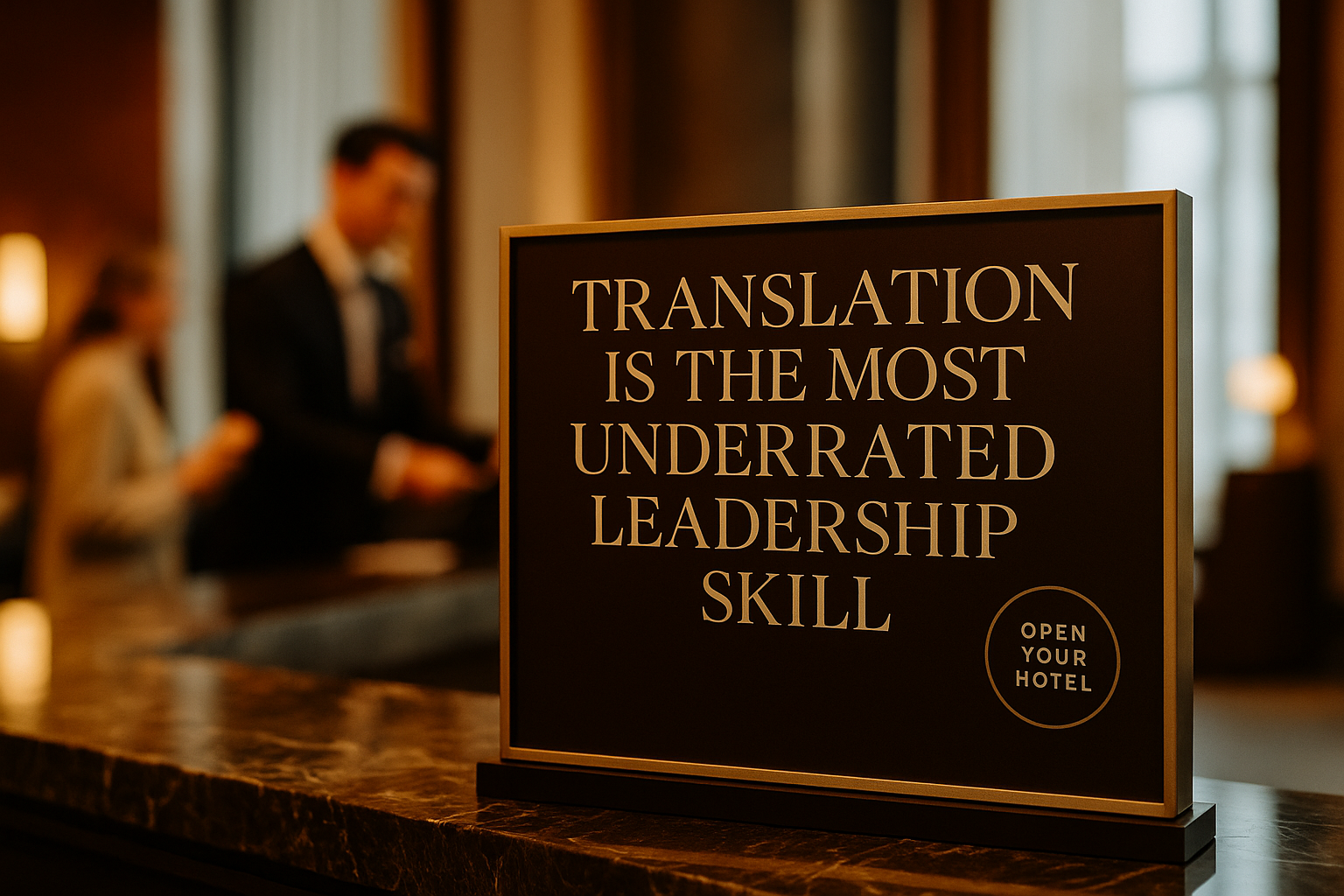
Translation is not communication — it is behavior-oriented leadership
Many leaders think they are clear because they have communicated. But communication is information.
Translation is behavior.
Translation occurs when a leader converts a complex message into something that feels workable, understandable, and human.
When
“enhancing guest interaction”
becomes a simple habit during a shift.
When
"improve collaboration departments"
becomes a regular occurrence between FO, HK, and F&B.
When
“steering commercial performance
becomes not a pressure point, but a calm, shared expectation.
It is the rehumanization of language in an industry that moves faster than people can keep up with.
In multi-stakeholder environments, translation becomes a leadership superpower.
In hospitality, complexity and emotion come together in real time.
Guests experience our clarity—or lack thereof—immediately.
And behind the scenes, the number of voices influencing a hotel has only increased:
owners who speak in financial terms
brands that communicate in lifestyle concepts
HQ teams that focus on consistency
local teams that look at workability
guests who long for connection and authenticity
In such an environment, leaders must be able to hear all voices—
—and translate them into a single message.
Not to simplify reality,
but to make it manageable.
The leaders who succeed are not those who try to control complexity,
but those who translate complexity into calm.
Why the future belongs to leaders who can translate
The coming years will not be any easier.
Margins remain tight.
Talent remains scarce.
Guest expectations continue to evolve.
Technology accelerates decisions.
Hotel portfolios are becoming more international and complex.
What teams need is not more urgency.
It's more clarity.
More rhythm.
Greater consistency in behavior.
Greater psychological safety.
More leaders who can translate the complexity around them into something people can follow—not fear.
We talk a lot about innovation, strategy, culture, guest experience commercial performance. But none of that matters without translation.
Translation turns ideas into movement.
Movement into behavior.
Behavior into culture.
And culture into performance.
Those who wish to translate this vision into concrete behavior in their daily operations will see this reflected in how OpenYourHotel guides organizations in their strategy positioning.
Final reflection
When you look at your own hotel, team, or portfolio:
Where does translation fall short?
Where do people interpret instead of understand?
Where does complexity undermine clarity?
Where do expectations lose their meaning before they reach the guest?
The answer to that question is exactly where your next transformation .
Discussing a similar challenge?